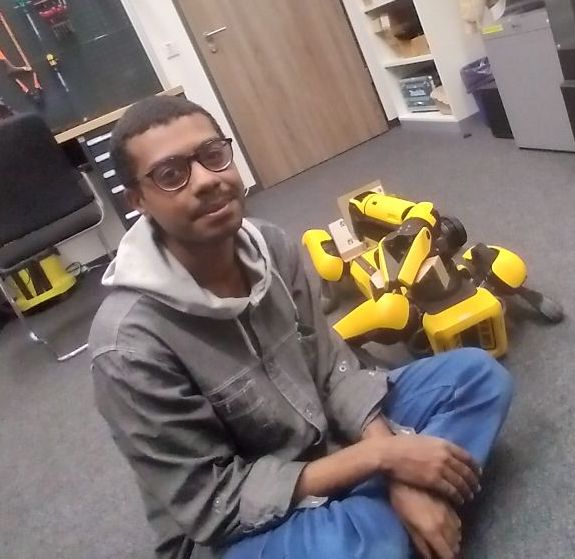
My research goal is to develop AI systems that can efficiently, adaptively, and safely assist humans in learning and achieving their goals.
I am particularly interested in how AI systems can understand and infer human goals and intentions, adapt their behavior to individual users and contexts,
and continually improve through interaction. To pursue this goal, I study assistive AI from three complementary perspectives: theoretical
frameworks for human-AI assistance and shared agency, models for human goal and intention inference, and learning algorithms for adaptive and personalized AI agents.
My research draws on reinforcement learning, human-AI interaction, probabilistic inference, continual learning, and agentic AI.
Experience
Research Intern Oct 2023 - Sep 2024
Mila-Quebec AI Institute, Montreal, Canada (Remote)
Teaching Assistant 2023
African Institute for Mathematical Sciences, Mbour, Senegal
Reseach Intern/Fellow 2022 - 2023
University of Tübingen and Max Planck Institute For Intelligent Systems,
Tübingen, Germany
Flutter Developer Nov. 2020 - Dec. 2020
Exit:Fund, Toronto, Canada (Remote)
Reseach Assistant 2019 - 2020
Institute for Space Research and Aerospace, Khartoum, Sudan
In International Conference on Learning Representations (ICLR), 2026
Roger Creus Castanyer, Faisal Mohamed, Pablo Samuel Castro, Cyrus Neary, Glen Berseth
Reinforcement learning (RL) algorithms are highly sensitive to reward function specification, which remains a central challenge limiting their broad applicability. We present ARM-FM: Automated Reward Machines via Foundation Models, a framework for automated, compositional reward design in RL that leverages the high-level reasoning capabilities of foundation models (FMs). Reward machines (RMs) – an automata-based formalism for reward specification – are used as the mechanism for RL objective specification, and are automatically constructed via the use of FMs. The structured formalism of RMs yields effective task decompositions, while the use of FMs enables objective specifications in natural language. Concretely, we (i) use FMs to automatically generate RMs from natural language specifications; (ii) associate language embeddings with each RM automata-state to enable generalization across tasks; and (iii) provide empirical evidence of ARM-FM's effectiveness in a diverse suite of challenging environments, including evidence of zero-shot generalization.
In International Conference on Learning Representations (ICLR), 2026
Faisal Mohamed, Cathrine Ji, Benjamin Eysenbach, Glen Berseth
Effective exploration in reinforcement learning requires not only tracking where an agent has been, but also understanding how the agent perceives and represents the world. To learn powerful representations, an agent should actively explore states that contribute to its knowledge of the environment. Temporal representations can capture the information necessary to solve a wide range of potential tasks while avoiding the computational cost associated with full state reconstruction. In this paper, we propose an exploration method that leverages temporal contrastive representations to guide exploration, prioritizing states with unpredictable future outcomes. We demonstrate that such representations can enable the learning of complex exploratory behavior in locomotion, manipulation, and embodied-AI tasks, revealing capabilities and behaviors that traditionally require extrinsic rewards. Unlike approaches that rely on explicit distance learning or episodic memory mechanisms (e.g., quasimetric-based methods), our method builds directly on temporal similarities, yielding a simpler yet effective strategy for exploration.
Adriana Hugessen*, Roger Creus Castanyer*, Faisal Mohamed*, Glen Berseth
Both entropy-minimizing and entropy-maximizing (curiosity) objectives for unsupervised reinforcement learning (RL) have been shown to be effective in different environments, depending on the environment's level of natural entropy. However, neither method alone results in an agent that will consistently learn intelligent behavior across environments. In an effort to find a single entropy-based method that will encourage emergent behaviors in any environment, we propose an agent that can adapt its objective online, depending on the entropy conditions by framing the choice as a multi-armed bandit problem. We devise a novel intrinsic feedback signal for the bandit, which captures the agent's ability to control the entropy in its environment. We demonstrate that such agents can learn to control entropy and exhibit emergent behaviors in both high- and low-entropy regimes and can learn skillful behaviours across MinAtar tasks.
Faisal Mohamed, Benjamin Eysenbach, Russ Salakhutdinov
Unsupervised skill learning methods are a form of unsupervised pre-training for reinforcement learning (RL) that has the potential to improve the sample efficiency of solving downstream tasks. Prior work has proposed several methods for unsupervised skill discovery based on mutual information (MI) objectives, with different methods varying in how this mutual information is estimated and optimized. This paper studies how different design decisions in skill learning algorithms affect the sample efficiency of solving downstream tasks. Our key findings are that the sample efficiency of downstream adaptation under off-policy backbones is better than their on-policy counterparts. In contrast, on-policy backbones result in better state coverage, moreover, regularizing the discriminator gives better downstream results, and careful choice of the mutual information lower bound and the discriminator architecture yields significant improvements in downstream returns, also, we show empirically that the learned representations during the pre-training step correspond to the controllable aspects of the environment.